The Little Prince – Chapter 5: Four Planets Level A2.1
Read along with Chapter 5 of The Little Prince in easy English.
Press play to listen to the audio. Each word lights up as it is read. Tap any word to see what it means.
This chapter is written for Level A2.1. It is good for kids and adults who know basic English
and are starting to read short stories in the past simple.
What Happens in Chapter 5?
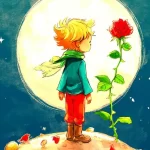
The little prince tells the pilot about his journey. Some birds carry him away from his planet, and he visits four tiny
planets with some very strange grown-ups. A king with nobody to rule wants the prince to work for him. A man writes down
the number of stars and thinks they belong to him. A lamplighter lights his lamp and puts it out every minute, because
his planet turns so fast – he is strange, but the prince likes him. Last, a writer says that flowers are not interesting
because they die. This makes the prince sad and he misses his flower. The writer tells him to visit Earth next.
New Words in This Chapter
- journey (noun) – a trip from one place to another, often a long one.
Their journey across the ocean took two weeks. - carry (verb, past: carried) – to hold something and take it with you.
Can you carry this bag for me? - king (noun) – a man who rules a country.
The king lived in a big castle. - number (noun) – a word or sign like 1, 2 or 3; how many there are.
What is the number of students in your class? - lamp (noun) – a thing that gives light.
I read with a small lamp next to my bed. - lamplighter (noun) – in the past, a person whose job was to light the street lamps.
Every evening, the lamplighter walked down the street. - put out (phrasal verb) – to stop a light or a fire.
Please put out the candle before you go to bed. - writer (noun) – a person who writes books or stories.
She wants to be a writer when she grows up. - die (verb) – to stop living.
Plants die without water.
Grammar Focus: There was / There were and first, second…
We use there was (one thing) and there were (more than one) to say what was in a place
in the past. We use first, second, third, fourth to put things in order.
- There was a king on the first planet.
- There were no other people.
- On the second planet, there was a man.
2 → second
3 → third
4 → fourth